Sidhika Tripathee
About Me
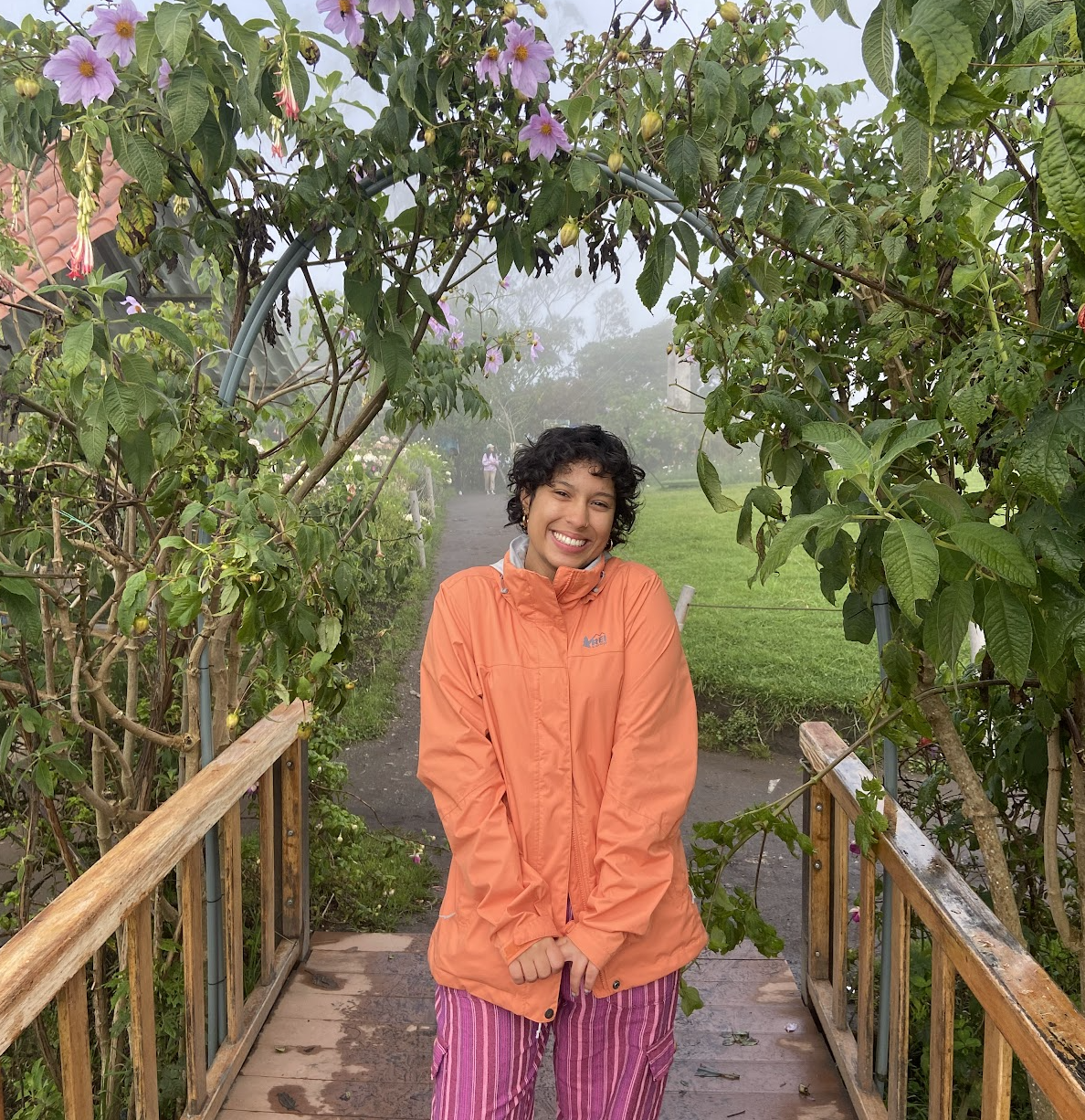
Welcome! My name is Sidhika Tripathee (Sid-ee-ka Tree-pah-tee) and I use she/her pronouns.
I'm pursuing an M.S. in Earth, Environmental and Planetary Sciences at Rice University, where I work in Dr. Sylvia Dee's Climate Lab. Before that, I earned a B.A. in Computer Science and Environmental Studies from Swarthmore College in 2022. My current research uses stable water isotopes to trace vertical mixing and study how it affects cloud cover in climate models and satellite observations.
I grew up in Kathmandu, Nepal, until I was 8, when I moved to the D.C. area. Even at that age, I noticed the stark differences in quality of life between my birthplace and my new home, and it led me to question the inequity in how resources are distributed. Now, seeing the unequal effects of climate disasters driven by anthropogenic climate change, I am motivated to find solutions to these challenges. This motivation led me to pursue a dual degree in Computer Science and Environmental Studies for my undergraduate studies. I am a strong proponent of interdisciplinary research, and I believe the intersection of computer science and climate science is a promising way to address the challenges posed by climate change.
As an undergraduate, I used machine learning to predict asthma rates in underrepresented communities for my senior capstone project. Over the summers, I interned at Microsoft as a Software Engineering Intern. After graduating, I worked as a software engineer (and ultimately Head of Engineering) at Generation Lab, a public-opinion polling startup, where I led a team of developers to build data pipelines and dashboards to analyze and visualize polling data.
But, I wanted to use my computational skills to work more directly on climate, so I decided to pursue graduate studies in climate science. I am currently pursuing my M.S. at Rice University (expected graduation June 2027). My coursework there includes Statistical Methods for Hydroclimate Extremes, Coastal Hazards in a Changing Climate, Remote Sensing, and Computer Vision. I am now looking at PhD programs (to start Fall 2027) that do applied work on predicting climate extremes and translating them into hazard and risk using climate models, satellite data, and machine learning.
I am a proud QuestBridge Scholar and received the Hannah A. Leedom Fellowship at Swarthmore. In my free time, I enjoy playing Ultimate Frisbee (I was on the Swarthmore Women’s Ultimate team, Go Warmothers!), reading, and making art!
Research
My current research interests lie in predicting climate extremes and translating them into hazard and risk by integrating climate models, satellite remote sensing, and machine learning, with an emphasis on decision-relevant science for early warning and adaptation planning.
-
Understanding cloud mixing relationships
Clouds are the largest uncertainty in climate model projections of future warming. To reduce that uncertainty, I am researching, at Rice University, the relationship between vertical mixing and cloud cover in stratocumulus clouds. Stable water isotopes are a powerful tracer of vertical mixing. I am using them to evaluate seven climate models from WisoMIP against satellite observations (AIRS, MODIS) and ERA5 reanalysis. I will present these results at AGU 2026 in the talk “Right Correlation, Wrong Physics: Isotopes Reveal Why GCMs Misrepresent Stratocumulus Cloud-Mixing Feedbacks,” and a manuscript is in preparation to be submitted in a peer-reviewed journal by early 2027.
-
Using machine learning to predict asthma rates in underrepresented communities
For my senior capstone project in the Swarthmore Computer Science department, I combined my passion for environmental justice with machine learning. In the absence of comprehensive datasets on environmental factors, I compiled my own with data from 324 counties across six states. I used machine learning algorithms such as decision trees and random forests to identify the social and environmental factors that contribute most to higher asthma rates within a community.
Publications & Presentations
-
2026
Oral presentationRight Correlation, Wrong Physics: Isotopes Reveal Why GCMs Misrepresent Stratocumulus Cloud-Mixing Feedbacks
AGU Annual Meeting 2026, PP13A-03, San Francisco, CA, 7 December.
-
In preparation
Evaluating Vertical Mixing and Low Cloud Cover in Isotope-Enabled GCMs Using Satellite Water Vapor δD
-
2026
SubmittedSpatiotemporal variability of stable isotopes in winter storm precipitation revealed by a crowd-sourced effort
Geoscience Data Journal.
-
2021
PosterMachine learning analysis of demographic and environmental factors associated with local asthma rates in the US
Swarthmore College Department of Computer Science, Swarthmore, PA.
Computational
Work
-
Cloud mixing feedbacks: in progress
For this research project, I use Python and xarray to analyze large datasets such as climate model outputs and satellite products. The code will be open-sourced on GitHub when the project is complete.
-
Predicting asthma rates with machine learning
For my senior capstone in Swarthmore’s Machine Learning course, I built my own dataset of 324 counties across six states, covering racial demographics, waste facility locations, PM2.5 concentrations, and asthma rates. I trained decision trees, random forests, logistic regression, and support vector machines in scikit-learn pipelines (standardization, PCA, grid search with 4-fold cross-validation) to classify counties at higher risk of asthma. I also mapped the dataset in GIS to show how waste facilities and asthma rates track communities of color in California.
-
Polling data pipelines and dashboard
While at Generation Lab, I built a polling database and data visualizations of young people’s views on key social and political issues for Inside Higher Ed and Let’s Grow Michigan. I also designed data scrapers to reach survey participants in under-surveyed demographics, increasing outreach by 150%. As Head of Engineering, I managed a team of five and developed AI and NLP methods for market research, including GPT-automated survey testing.
-
Web development for Mentorship Site
Through Develop for Good, I volunteered to build a scheduling website for Boba Talks, a mentorship program for early-career professionals in the tech industry.
-
EyeDropper API
During a 2020 internship at Microsoft, I developed a JavaScript API for the Chromium browser that lets developers use the browser’s built-in eyedropper when building custom color pickers. The API landed in Microsoft Edge Canary in week 10 of the internship.
-
Improving scrolling on Chromium
During a 2021 internship at Microsoft, I worked on Chromium open-source code to improve keyboard scrolling metrics. I unified keyboard and gesture scrolling by redesigning keyboard scrolling as gesture-based scrolling, which improved keypress metrics in Chromium-based Edge by 72%.
Teaching &
Outreach
-
Critical Theory of Technology
Created the curriculum for and taught the first student-run course in Swarthmore College’s CS department, “The Critical Theory of Technology”, to 10 students from across departments.
-
Teaching Assistant at Swarthmore College for Environmental Studies
Taught students farming techniques, including planting, weeding, plot preparation, and harvesting, in the “Our Food” course.
-
Tutor
Tutored students one-on-one through Swarthmore’s Dean’s Tutor Program and independently in college-level computer science (intro CS, computer systems, data structures and algorithms), math, and English as a Second Language.
-
Equity and Inclusion Committee, Rice EEPS
I serve on my department's Equity and Inclusion Committee, where I designed and ran a department-wide survey of graduate students' professional and personal needs and wellbeing, and presented the results to faculty. I also helped create a peer mentoring program for graduate students in the department.
-
Sustainability at Rice
As an elected member of the Graduate Student Association's Sustainability Committee, I started a successful composting initiative for graduate housing residents and brought undergraduate and graduate clubs together to run a clothing mending workshop.
-
Environmental justice in Chester, PA
As a fellow with the African Diaspora Earthcare Coalition, I worked with community elders to make plant medicine tinctures for residents of Chester, PA, a community harmed by racialized disinvestment and pollution from the largest trash incinerator in the US. I also did community education on plant medicine and environmental justice.
-
Inclusion in computer science
On Swarthmore's CS Advisory Council, I created a peer mentorship matching program for underrepresented CS majors and worked with faculty to bring ethics into intro courses. I also co-founded Tech for Social Good, which ran a speaker series on ethics and technology.